Embedded Files

Important content:
Important content:
- Covalent bond
- Ionic bond
- Metallic bond
- Polarity
- Intermolecular forces (hydrogen bonds and Van der Waal forces)
important resource: dynamic Periodic Table
important resource: dynamic Periodic Table
Chemical bondS to be more stable
Chemical bondS to be more stable
Living things are made up of atoms, usually interacting with other atoms (or groups of atoms).
Atoms might be connected by strong bonds which hold molecules together. Or they might form temporary, weak bonds with other atoms, creating temporary connections. Both type of bonds are essential to the chemistry of our bodies, and to the existence of life itself.
Why form chemical bonds? The basic answer is that atoms are trying to reach the most stable (lowest-energy) state that they can. Many atoms become stable when their valence shell is filled with electrons (notes that it happens in noble gas' group). If atoms don’t have this arrangement, they will try to reach it by gaining, losing, or sharing electrons via bonds.

Why do atoms bond?
Why do atoms bond?
INTRAMOLECULAR BONDS
INTRAMOLECULAR BONDS
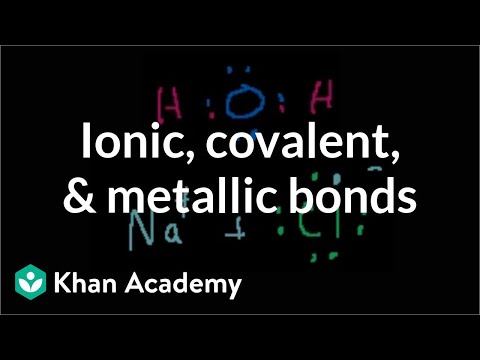
Atoms may bond together to attain more stable electron configurations. The electrons taking part in a bond are called bonding electrons. We can define three types of bonding:
Covalent Bond
Covalent Bond
forms when atoms share electrons in order to complete the outer shell to be more stable.
IONIC Bond
IONIC Bond
forms when attoms are held together by the attraction between opposite charges.
Metallic Bond
Metallic Bond
forms when sharing of free electrons among a structure of positively charged ions (cations). It happens between the atoms of metallic elements that lose their valence electrons to an electron cloud.


Polarity in covalent bonds
Polarity in covalent bonds
When one of the atoms is more electronegative than the other its nucleus attracts higher the electrons, so they move about closer to the nucleus, causing unequal distribution of electric charge.
A covalent bond is polar if the charge distribution is unequal, and nonpolar if the distribution is equal. Water is a current example of a polar molecule. Let's try to undestand the reason with the following images:


Using Oxidation Numbers
Using Oxidation Numbers
- Oxidation numbers allow us to know the relative amounts of the atoms of each element in a compound.
- The sum of the oxidation numbers of a compound's atoms is 0.
- Many elements have more than one oxidation number and it depends on the type of the compound that they form.
- In a ionic compound the oxidation number is equal to the net charge of each atom in a ionic form.
Intermolecular forces
Intermolecular forces
Intermolecular forces are attractive forces exerted between molecules. These forces are less strong than those chemical bonds but they also determine the properties of molecular substances.
There are two types of intermolecular forces:
Hydrogen bonds
Hydrogen bonds
VAN DER WAALS FORCES
VAN DER WAALS FORCES
Are also known as London forces or dispersion forces. Although they are often called the "weakest" forces Van der wall forces are actually the most important since it is ubiquitous. Every molecule has dispersion forces. The degree to which a molecule has dispersion forces is measured via its polarizability.
More information

An overView of intermolecular and intramolecular forces
An overView of intermolecular and intramolecular forces

Assess your learning proCESS
Assess your learning proCESS

Building Chemistry
Building Chemistry
PART 2: Bonding!
PART 2: Bonding!
Each student would have to create and explain an molecule after the bonding of the atoms. To do, you must take into account the conceptual framework of this part. It is important to highlight that you will have to apply the contents of this part. As always: be visual and creative!

And... go further asking more questions on this topic and finding the answers!!!
And... go further asking more questions on this topic and finding the answers!!!
Report abuse