Embedded Files
How I developed criteria for materials, assessments and feedback
At my current school, we utilize standards-based grading (SBG). In science, we use two different groups of standards in our online gradebooks. One group are content standards, which are grouped as "Power Standards." These are active statements based on the different disciplinary core ideas (DCI) in the NGSS. The second group are skill-based standards, which are the science and engineering practices (SEP) in the NGSS. As a department in Sept 2019, we designed or revised common rubrics to assess students' skills in any type of assessment. Where I found them to be confusing or unuseful is I did not understand what the actual criteria were that we were looking for in the students' work.
During the summer break, during the pandemic, I studied the SEP strands and department rubrics to identify what kind of criteria I needed to give students for assignments, skills I needed to teach, and content to use in feedback. The NGSS is quite laughable with some of it's expectations.... such as "Critically read scientific literature adapted for classroom use to determine the central ideas or conclusions and/or to obtain scientific and/or technical information to summarize complex evidence, concepts, processes, or information presented in a text by paraphrasing them in simpler but still accurate terms." Notice the eight-to-last word is paraphrasing. It took me a while to digest what this was even saying. Some of the SEP rubrics repeated the confusing language from the strands (not this one, thankfully), and that's when I came up with the document below.
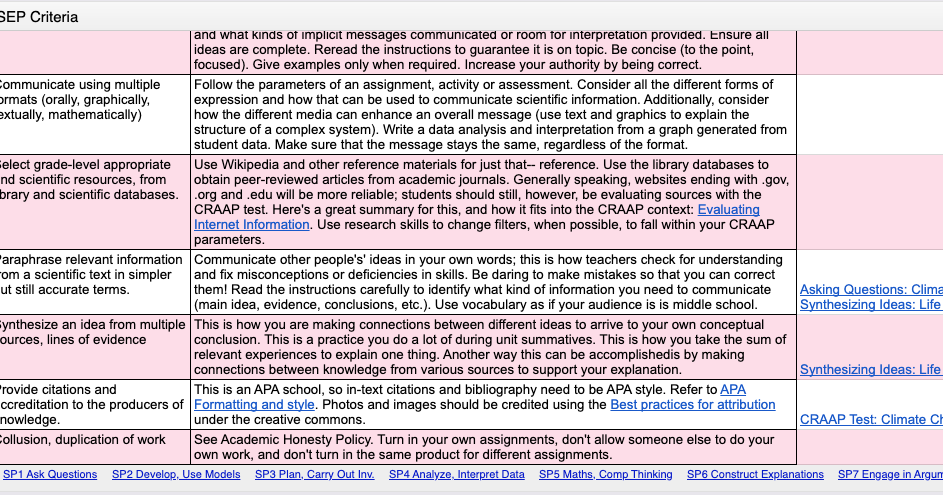
Below is a master list of the specific criteria I use in evaluating student work. The relevant criteria for individual assignments is explicitly reviewed during the instructions, so students know what they are aiming to do as they use creative and critical thinking, leading up to the summative assessment.
Some SBGrades come from the demonstration of scientific practices. How students will know if they'll be successful at these practices is because we will be using them on a daily basis. Each lesson and/or activity is designed to provide meaningful development or use of a few at a time. All feedback students will receive will be based on these criteria. If there is a deficiency, students will receive strategies on how to remedy it. Students will then be provided opportunity to revise their work using the feedback they received.
This is a living document. As I identify criteria I lack, I will add those to the respective SEP. As I receive feedback about the clarity of my criterion-based comments, I will revise the clarifications to reflect needs of students and authentic applications in class.

Reflecting on Feedback
Reflecting on Feedback

26 August 2020: "Tragedy of the Commons" Formative Feedback
26 August 2020: "Tragedy of the Commons" Formative Feedback
This wordle represents the most common terms in my first attempt at improving the quality of my feedback (focus, function, amount) for my APES course. The words "good", "well" and "done" were used to specifically say "You have a good understanding" and "Well done" after providing criterion-referenced feedback; I did this to be more explicit about how they are doing after the commentary of their work. This assignment was assessed using criteria for making an accurate and complete claim using multiple lines of evidence. I like that you can see "evidence", "complete", "parts" referencing the multiple lines, "claim(s)" and "understanding" at the forefront. About two-thirds of the way through I realized I should be writing "you have an accurate understanding of TOTC" rather than "you have a good understanding".
Something I know I am striving improve is being more concise, not only in my instructions but also in my feedback. I do struggle with the amount of feedback to provide. I am curious to see how working on that area will impact the kinds of words prominently displayed in another worlde.
27 August 2020: "Evaluating Claims About Climate Change" Formative Feedback
27 August 2020: "Evaluating Claims About Climate Change" Formative Feedback
This wordle represents the most common terms in my first attempt at improving the quality of my feedback (focus, function, amount) for my Earth Science course. The words "well" and "done" were used to specifically say "Well done" after providing criterion-referenced feedback; I did this to be more explicit about how they are doing after the commentary of their work. This assignment was assessed using criteria for providing APA bibliographic citations for sources and using the CRAAP test to evaluate sources. This was the second formative I graded of the school year, and I was using my reflection from the TOTC feedback to improve the amount and focus. I like that you can see "evidence", "claim", "evaluated" and "criteria" referencing using the CRAAP test, and "APA" for the citation.
In reference to being more concise, I want to be able to reference the specific ways students achieve at the criteria but without needing to provide a full narrative why. I strive to be concise, direct and specific with the strategies for improving skills and quality of work.
Even as I currently work on writing feedback for a third formative assessment this school year, I believe by being more conscious about the amount of feedback I am providing, I am doing better. I will need to, however, build a routine of having students review their feedback as well as providing me feedback about what I am providing them. This may reveal that I am providing adequate feedback, or that I may need to teach how to use feedback, or who knows!

Related Blog Posts
Related Blog Posts
Page updated
Google Sites
Report abuse