
Stained Glass
Embedded Files
Stained glass is an art form that involves arranging colored pieces of glass. The black lines that hold the glass pieces together are called lead. Stained glass windows have a bright glowing quality when illuminated from behind.

Stained glass refers to coloured glass as a material or art and architectural works created from it. Although it is traditionally made in flat panels and used as windows, the creations of modern stained glass artists also include three-dimensional structures and sculpture.
Stained glass possesses an aura of mystery and romance. It is the interplay between light and color that sparks the imagination. It is one of the most unchanged crafts, still taking, as it did centuries ago, time and patience, and an appreciation for color and line design.

How it's Made
As a material stained glass is glass that has been coloured by adding metallic salts during its manufacture. It may then be further decorated in various ways. The coloured glass may be crafted into a stained glass window, say, in which small pieces of glass are arranged to form patterns or pictures, held together (traditionally) by strips of lead, called cames or calms, and supported by a rigid frame. Painted details and yellow-coloured silver stain are often used to enhance the design. The term stained glass is also applied enamelled glass in which the colors have been painted onto the glass and then fused to the glass in a kiln.
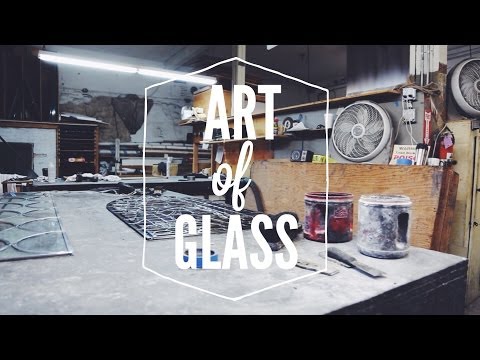
During the late medieval period, glass factories were set up where there was a ready supply of silica, the essential material for glass manufacture. Silica requires a very high temperature to melt, something not all glass factories were able to achieve. Such materials as potash, soda, and lead can be added to lower the melting temperature. Other substances, such as lime, are added to make the glass more stable. Glass is coloured by adding metallic oxide powders or finely divided metals while it is in a molten state. Copper oxides produce green or bluish green, cobalt makes deep blue, and gold produces wine red and violet glass. Much of modern red glass is produced using copper, which is less expensive than gold and gives a brighter, more vermilion shade of red. Glass coloured while in the clay pot in the furnace is known as pot metal glass, as opposed to flashed glass.

In Our Story
In The Tale of Despereaux, stained-glass windows and light symbolize good and hope, while dark places represent evil.
“But Despereaux wasn’t listening to Furlough. He was staring at the light pouring in through the stained-glass windows of the castle. He stood on his hind legs and held his handkerchief over his heart and stared up, up, up into the brilliant light.
‘Furlough,” he said, “what is this thing? What are all these colors? Are we in heaven?’” (p.

History
Many histories of stained glass begin with Pliny’s tale of the accidental discovery of glass by Phoenician sailors. The legend recounts shipwrecked sailors who set their cooking pots on blocks of natron (soda) from their cargo then built a fire under it on the beach. In the morning, the fire’s heat had melted the sand and soda mixture. The resultant mass had cooled and hardened into glass. Today, though, it is thought that Pliny — though energetic in collecting material — was not very scientifically reliable. It is more likely that Egyptian or Mesopotamian potters accidentally discovered glass when firing their vessels. The earliest known manmade glass is in the form of Egyptian beads from between 2750 and 2625 BC. Artisans made these beads by winding a thin string of molten glass around a removable clay core. This glass is opaque and very precious.


Coloured glass has been produced since ancient times. Both the Egyptians and the Romans excelled at the manufacture of small colored glass objects. Phoenicia was important in glass manufacture with its chief centres Sidon, Tyre and Antioch. The British Museum holds two of the finest Roman pieces, the Lycurgus Cup, which is a murky mustard color but glows purple-red to transmitted light, and the cameo glass Portland vase which is midnight blue, with a carved white overlay.


The creation of stained glass in Southwest Asia began in ancient times. One of the region's earliest surviving formulations for the production of colored glass comes from the Assyrian city of Nineveh, dating to the 7th-century BC. The Kitab al-Durra al-Maknuna, attributed to the 8th century alchemist Jābir ibn Hayyān, discusses the production of colored glass in ancient Babylon and Egypt. The Kitab al-Durra al-Maknuna also describes how to create colored glass and artificial gemstones made from high-quality stained glass. The tradition of stained glass manufacture has continued, with mosques, palaces, and public spaces being decorated with stained glass throughout the Islamic world. The stained glass of Islam is generally non-pictorial and of purely geometric design, but may contain both floral motifs and text.
Stained glass creation had flourished in Persia (now Iran) during the Safavid dynasty (1501–1736 A.D.), and Zand dynasty (1751–1794 A.D.).In Persia stained glass sash windows are called Orosi windows (or transliterated as Arasi, and Orsi), and were once used for decoration, as well as controlling the incoming sunlight in the hot and semi-arid climate.


In early Christian churches of the 4th and 5th centuries, there are many remaining windows which are filled with ornate patterns of thinly-sliced alabaster set into wooden frames, giving a stained-glass like effect.
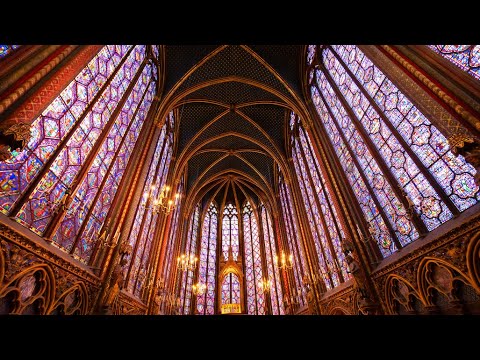
Evidence of stained-glass windows in churches and monasteries in Britain can be found as early as the 7th century. The earliest known reference dates from 675 AD when Benedict Biscop imported workmen from France to glaze the windows of the monastery of St Peter which he was building at Monkwearmouth. Hundreds of pieces of coloured glass and lead, dating back to the late 7th century, have been discovered here and at Jarrow.
Modern Times


There are a number of glass factories, notably in Germany, the United States, England, France, Poland and Russia, which produce high-quality glass, both hand-blown (cylinder, muff, crown) and rolled (cathedral and opalescent). Modern stained-glass artists have a number of resources to use and the work of centuries of other artists from which to learn as they continue the tradition in new ways. In the late 19th and 20th centuries there have been many innovations in techniques and in the types of glass used. Many new types of glass have been developed for use in stained-glass windows, in particular Tiffany glass and dalle de verre.


While the ecclesiastical history of stained glass is well known and visible in popular culture and media, less so are the craft’s innovations in the twentieth century. Following World War II, there was a proliferation of new work in stained glass. In Germany, where much medieval stained glass had been damaged or destroyed by bombing, churches began the work of repair. German artists like Georg Meisterman, among others, presented a strong architectural engagement with stained glass during this period. Innovating in their abstracted compositions and use of lead, often their stained-glass works were evocative of the death and mourning pervading post-war German society. These artists helped to establish West Germany as a hub for stained-glass education that attracted numerous artists from around the world. One such artist, Robert Sowers, studied stained glass in the United Kingdom and traveled to see this new style of glass in Germany. His subsequent artistic work and published writings supported the emergence of stained glass as an architectural art form in the United States, as did his involvement with MAD, at that time called the Museum of Contemporary Crafts, which would last decades.

In America
Glass making was the first industry set up in America in Jamestown, settled in 1607. The English were running out of wood to fuel their furnaces. The endless forests and sand in the New World dictated the choice. To reassure his English investors, Captain John Smith wrote that the glass-making venture was a success, but the operation was very short lived. Bottles and window glass were the primary glass products of this venture.
Local Artist - Bosgraff Studios

Bosgraaf Studio designs and fabricates custom stained glass for architects, home-owners, churches, and anyone who is interested in creating a beautiful atmosphere that stained glass provides.
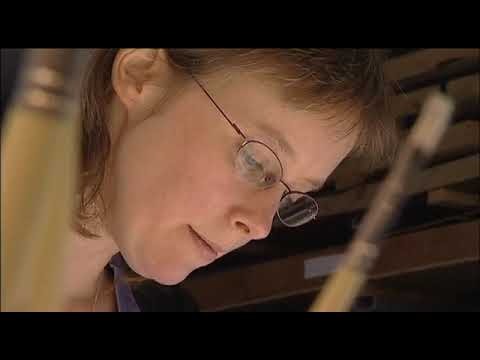
Peggy Corcoran, Bosgraaf’s owner and principal artisan and instructor, creates custom designs, and fabricates and installs original stained glass.
Corcoran has been working with stained glass for over twenty years. With a background in furniture making, and strong familiarity with the demands of building, Peggy brings a comprehensive expertise that makes her stained glass commission work highly sought after by professionals. Considered the architects’ and designers’ choice for stained glass in South County and beyond, Peggy has been hired by churches, homeowners, architects and interior designers to create unique custom glass in a variety of environments.


Since opening Bosgraaf Studio in 2005, Peggy has also been offering stained glass classes. Beginning students are welcome as are intermediate students and fused glass artisans. Bosgraaf Studio also provides a variety of stained glass and glass fusing materials for students and visitors to purchase in the studio retail store.
Peggy invites you to stop by Bosgraaf Studio to pick up stained glass supplies, ask about taking a class, or to discuss your custom project.
Page updated
Google Sites
Report abuse