Embedded Files

What are Running Records?
What are Running Records?
Running Records are records of children reading continuous text that provides different kinds of information from tests of letters, sounds and words in isolation.
Running Records are not limited to a particular theory of literacy learning.
If Running Records are taken in a systematic way, they provide evidence of how well children are learning to direct their knowledge of letters, sounds and words to understanding the messages in the text.
(Clay, M. (2017). Running Records for Classroom Teachers 2nd Edition (2nd Edition, Vol. 2). Heinemann)
How to do a Running Record
How to do a Running Record
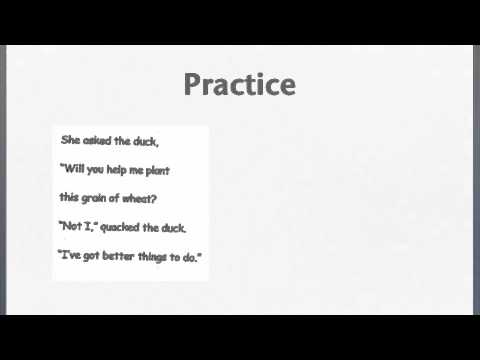
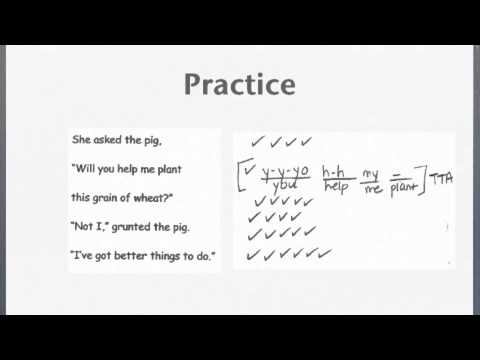
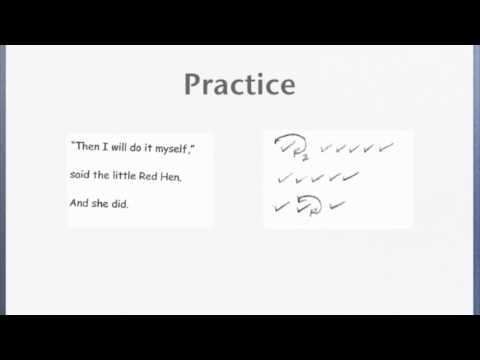
 Recording Conventions 2020.pdf
Recording Conventions See pages 15 - 18 of Running Records for Classroom Teachers Book
Recording Conventions See pages 15 - 18 of Running Records for Classroom Teachers Book

Scoring
Scoring

Refer to page 21 - 23 of Running Records for Classroom teachers by Marie M. Clay, second edition.
Review the Running Records of the child's behaviour on the book(s) you have selected and consider what was happening as the child read. Consider each error only up to and including the error (not the unread text).
If a student scores between 96 - 99.5% accuracy, the text is too easy and the student can move on to the next level.
If the student scores between 90 - 95% accuracy, the text is at the instructional level, and should continue reading at this level.
If the student scores between 50 - 89% accuracy, the text is too difficult and the teacher should consider moving down a level.
(Clay, M. (2017). Running Records for Classroom Teachers 2nd Edition (2nd Edition, Vol. 2). Heinemann)
Interpreting Running Records
Interpreting Running Records
ERROR
It is important to analyse every error to identify the kinds of information used. Look only at the sentence up to the error. Ask yourself, 'What led the child to do or say that?' For every error, ask yourself at least three questions:
Meaning: Did the meaning or the messages of the text influence the error? Perhaps the reader brought a different meaning to the author's text. Did it make sense?
Structure: Did the structure of the sentence up to the error influence the response? If the error on the first word of the sentence, it is marked as positive for structure if the new sentence could have started that way. Did that sound right?
Visual Information: Did visual information from the print influence any part of the error: Letter, cluster or word? Did that look right?
(Clay, M. (2017). Running Records for Classroom Teachers 2nd Edition (2nd Edition, Vol. 2). Heinemann)
SELF CORRECTION
Often readers make errors and without any prompting, work on the text in some way and self-correct errors. Ask yourself, 'What led the child to do this?' (Clay, M. (2017). Running Records for Classroom Teachers 2nd Edition (2nd Edition, Vol. 2). Heinemann)
Refer to page 27 of Running Records for Classroom teachers by Marie M. Clay, second edition.
What to do with the information from the Running Record
What to do with the information from the Running Record


Here is an example of a completed Running Record on an Easy level.
"Comment on what the reader did well.
Was the text read at a good pace, or was it slow, or too fast/
Was he/she reading groups of words together in a phrased way?
Did the child's intonation and expression indicate understanding of the text?
Attend particularly to change over previous readings."
Page 18 of Running Records for Classroom teachers by Marie M. Clay, second edition.
Frequency
Frequency
It is good practice to use Running Records regularly in junior classes. Talk to your school about their expectations. Some schools use different reading assessments such as PM Benchmark and Probe. Chat with your literacy lead regarding specific school expectations for your school.
It is good practice to use Running Records regularly in junior classes. Talk to your school about their expectations. Some schools use different reading assessments such as PM Benchmark and Probe. Chat with your literacy lead regarding specific school expectations for your school.

Page updated
Report abuse